
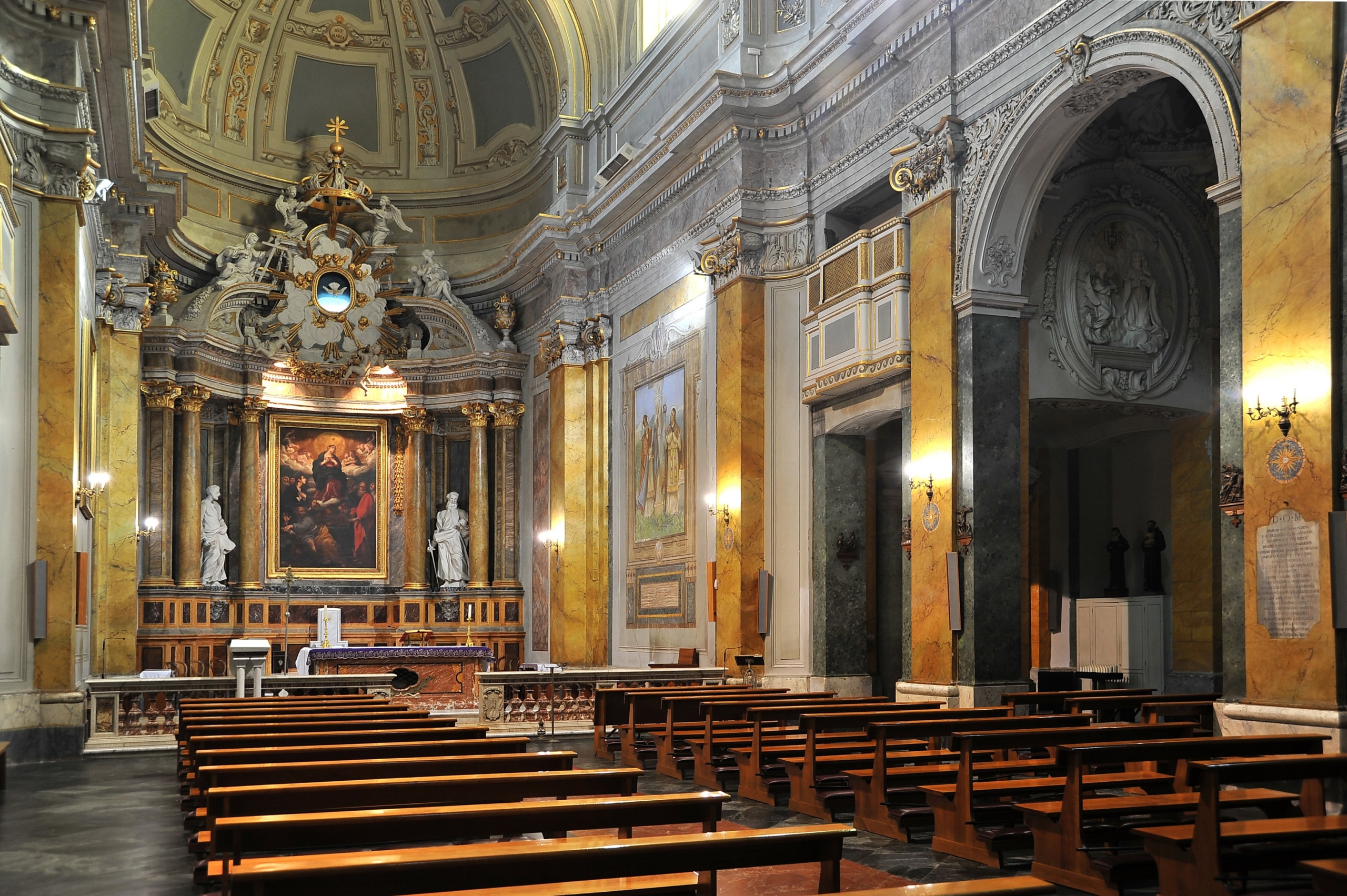
Welcome to the Cathedral of Saint Mary of the Assumption. Let me introduce myself: I am Giovanni Baglione, painter, writer, and, by the grace of His Holiness, a Knight. Perhaps my name is new to you, or perhaps you know me for my rather “distinctive character” and for the chronicles of the Roman courts. I admit it: history often remembers me as the bitter enemy and rival of Michelangelo Merisi, known as Caravaggio. A difficult, tormented man, who never missed an opportunity to mock me with venomous rhymes. But, as you know, time is a gentleman.
If I am here today, it is not to talk to you about old Roman grudges, but to accompany you on a journey of discovery through this place, which houses one of my works.
You should know that Poggio Mirteto was founded around the middle of the thirteenth century as a military stronghold by the local lords, but it soon came under the rule of Farfa. It was under the influence of this Abbey that the castle began to change its appearance.
The fortress became the residence of the commendatory abbots. A first church was built within the walls, but as the population grew, a larger place of worship became necessary. The community decided to build a new church outside the walls, in what would later become the large square, just beyond the gate commissioned by Cardinal Alessandro Farnese.
The construction of the church you see before you was entrusted to the architect Martino Longhi the Younger in 1641, but it was certainly not a short undertaking. Due to financial difficulties and various setbacks, construction lasted a remarkable 144 years. The sacred building was blessed only in 1684 and became fully operational in 1721. In fact, its official consecration had to wait until as late as October 3, 1779.
But the real turning point came in 1841, when Pope Gregory XVI elevated Poggio Mirteto to the status of a diocesan see. It was at that moment that this parish church officially became a Cathedral.
Now, let us discover the works of art that embellish this church.
