Let me now accompany you to admire the final chapel, commissioned in 1690 by the Company of Santa Maria di Agosto.
On the altar stands a painting depicting the Passing of Saint Joseph, that is, the moment of his passage from earthly life, lovingly attended by Mary and Jesus. The work, notable for the delicacy of its composition, is attributed to Francesco Trevisani, a master who achieved considerable success in late Baroque Rome.
In the foreground, observe the figure of Saint Nicholas of Bari. He appears sumptuously dressed in the vestments of an Eastern bishop, holding his pastoral staff. At his feet, you will notice three golden spheres, symbols of the famous act of charity performed by the saint for three poor young women, whom he helped so that they could marry.
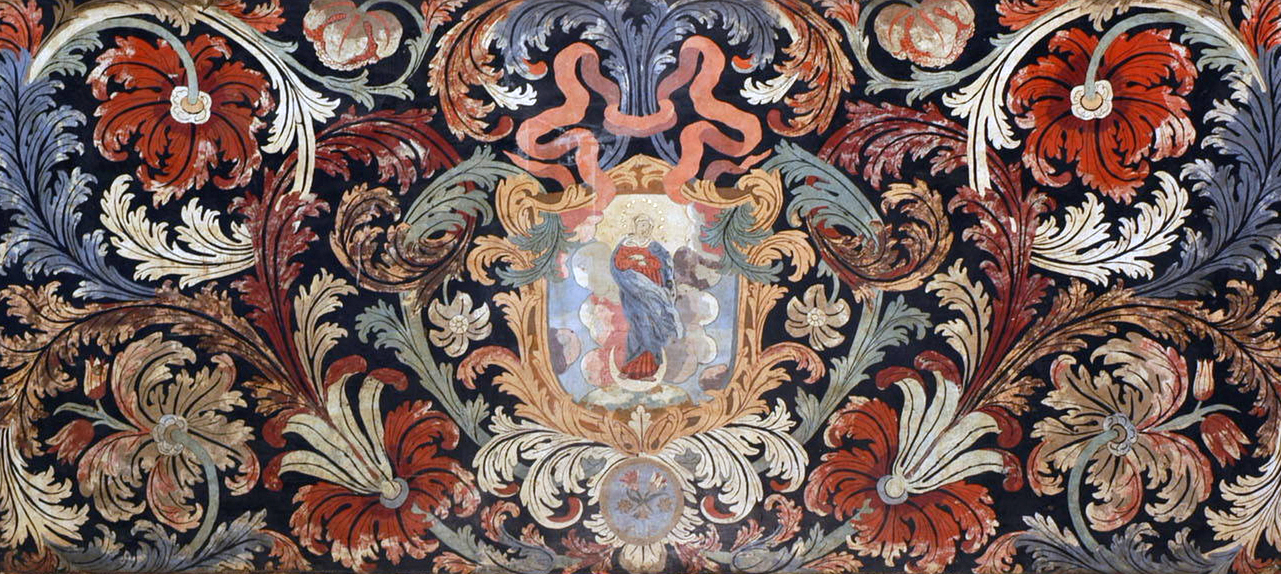
Also belonging to this altar, do not overlook the scagliola altar frontal, with its rectangular base and painted decoration, featuring the Immaculate Virgin at the centre amid elegant vegetal scrolls.
Finally, raise your eyes to contemplate the abundant stucco decoration. In the dome, the Holy Spirit appears in glory among angels, surrounded by clouds and holding a garland. The pendentives contain three prophets and King David, recognizable by his crown and by the harp he holds in his hands. Above the door, Christ is depicted handing the keys to Saint Peter.
As you leave, look up at the façade. At the top, you will notice the town’s coat of arms, placed there as a symbol of the pride of the people of Poggio Mirteto in having brought this monumental undertaking to completion through their own efforts.
Take a moment to admire its solid, proud terracotta façade, overlooking Piazza Martiri della Libertà. It is a giant that has witnessed centuries of history, from the rule of the Abbots of Farfa to the arrival of Garibaldi in 1867.
I invite you to continue your walk, allowing yourselves to get lost among the narrow streets of the historic centre and discover its many evocative views.
Enjoy the rest of your visit, and until we meet again!
