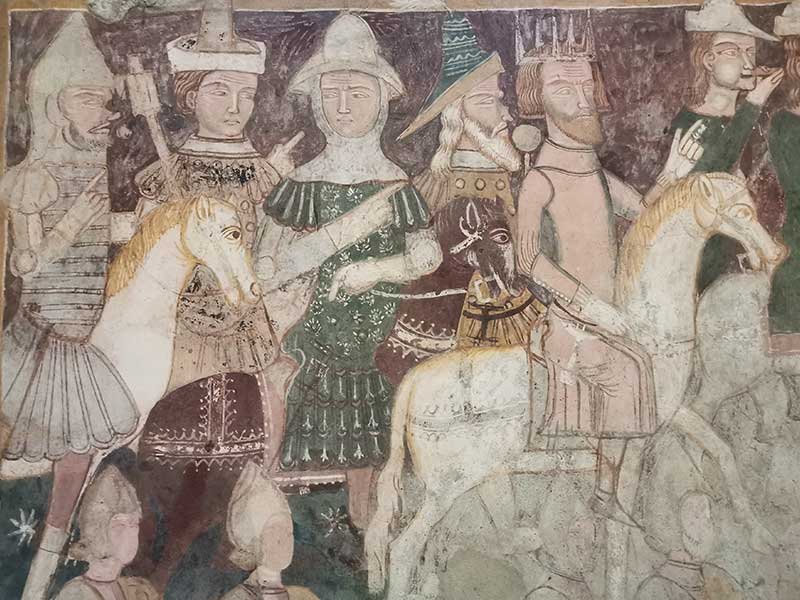
At the beginning of the right nave, one can admire the only two surviving panels of a more extensive cycle depicting the life of Saint William of Malavalle, founder of the Guglielmites. These monks occupied the abbey after the Benedictines, from 1286 to 1445.
The paintings depict an episode taken from the Vita, written by Theobald in the 13th century. This text combined the biographies of two different historical figures: William, tenth Duke of Aquitaine, and William of Malavalle, a hermit near Castiglione della Pescaia. These figures share not only the same name, but also a noble social status and a conversion to monastic life.
The frescoes, datable to the late 14th century, portray William of Aquitaine, a staunch opponent of Pope Innocent II, on horseback, accompanied by his army. The duke wears a crown and a rich garment. Around him are soldiers, attendants, and trumpeters announcing the arrival of the powerful duke. In the panel on the right, his conversion, brought about through Saint Bernard of Clairvaux, is depicted. After celebrating Mass, Saint Bernard brought the Blessed Sacrament before the duke, who fell from his horse and lay stunned. Once helped up, he fell again. It was then that Saint Bernard commanded him to rise and listen to the word of God. William stood up and began his path of conversion.
Let us now turn toward the first arch separating the central nave from the right one: the head of a saint can be glimpsed, while on the wall that divides the right nave into two sections, the full figure of a monk can be recognized, depicted together with the donor at his feet.
We must now move outside the church and take the path on the right.
